
A question that comes up often enough in Bible study to deserve its own answer: is Paul's Letter to the Ephesians the same document as the letter addressed to the church in Ephesus in Revelation 2:1-7? It is not. They are two separate letters, written by two different figures, roughly a generation apart, to the same congregation. Read side by side, they trace something no single letter shows on its own: what happened to one specific church over about thirty years.
Two Different Letters, Same Church
Paul's letter, on the traditional dating, was written around 60 to 62 AD, during his imprisonment in Rome, to a congregation he had founded and led in person for close to three years. The letter in Revelation 2:1-7 was written by John, from exile on the island of Patmos, generally dated to around 95 AD, near the end of the reign of the emperor Domitian, roughly a generation later. Both letters are addressed to the same city and, presumably, an evolved version of the same congregation, but they are different documents, by different authors, responding to different circumstances, separated by enough time that essentially no one who received Paul's letter in person would still have been leading the congregation by the time John's letter arrived.
For the setting in which Paul wrote, read the historical context of Paul's letter.
This is a source of genuine, understandable confusion, since both are commonly shortened in conversation to "the letter to Ephesus," and both appear in the same New Testament without an obvious signpost distinguishing them for a casual reader.
What Paul's Letter Says About the Ephesian Church
Paul's letter, as covered in full in our Letter to the Ephesians guide, is theological and constructive in tone. It describes the church's calling, its unity across Jewish and Gentile lines, and closes with practical instruction for household and spiritual life. There is no rebuke in Paul's letter, no correction of specific doctrinal error within the congregation, a marked contrast with several of his other letters written to churches he considered to be in active trouble, such as Galatians or 1 Corinthians.
What Changed by the Time John Wrote
John's letter in Revelation 2:1-7 opens with real praise: perseverance, hard work, and a clear rejection of "those who claim to be apostles but are not" (2:2), along with a specific commendation for rejecting the Nicolaitans, a group also condemned in the letter to Pergamon later in the same chapter. By every institutional measure, the Ephesian church had held its doctrinal ground.
Then comes the letter's central rebuke, one of the most quoted lines in the whole book: "Yet I hold this against you: You have forsaken the love you had at first" (2:4). The church that Paul had described in glowing, purely constructive terms a generation earlier had, by John's account, become institutionally strong and doctrinally vigilant while losing something relational and immediate that had characterized it at the start. John's remedy is direct: "Consider how far you have fallen! Repent, and do the things you did at first" (2:5), with a warning that failure to do so would mean the church's "lampstand" being removed from its place, generally read as the congregation's standing or its very continuation being at risk.
Reading Them Together
Read in sequence, the two letters trace an arc: constructive theological formation under a founding apostle, followed a generation later by an institution that has hardened in the process of defending itself successfully. Several commentators read this trajectory as a case study in a pattern that recurs across church history broadly, that doctrinal vigilance and relational warmth do not automatically reinforce each other and can, over enough time and enough institutional success, actually trade off against one another.
Ephesus is not the only city to receive letters from more than one biblical author. Laodicea appears both in Revelation 3:14-22 and, more briefly, in Paul's earlier letter to the Colossians (Colossians 4:16), where Paul mentions a letter to the Laodiceans that has not survived. But Ephesus is the clearest and most complete case of the same congregation receiving two full, comparable letters a generation apart, which makes the comparison unusually direct.
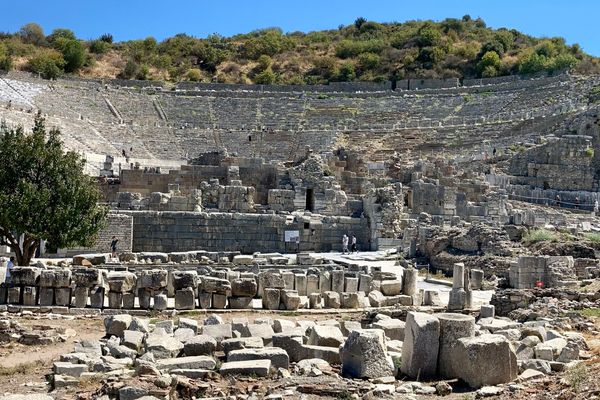
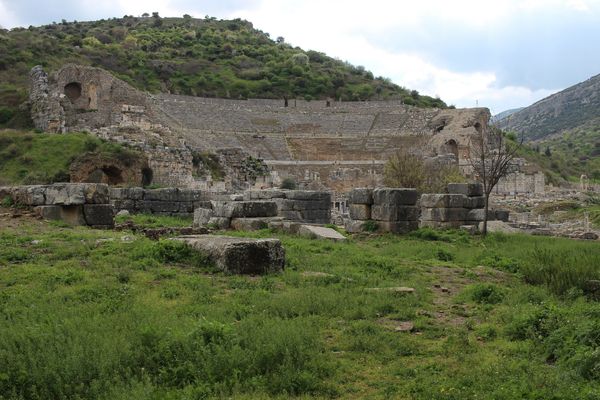
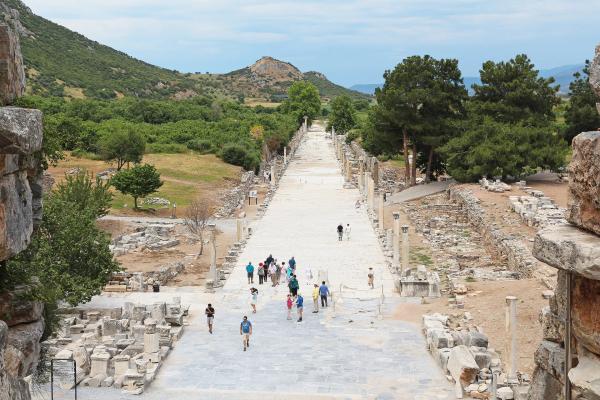
For the fuller treatment of John's letter and the six other churches addressed alongside Ephesus in Revelation, see our Seven Churches of Revelation guide and the dedicated Church of Ephesus in Revelation page. For where this congregation's physical remains stand today, continue to where the Ephesian church actually stood.
Both letters were addressed to the same congregation, and the site they describe can still be walked. Our three-night Seven Churches route from Kuşadası covers Ephesus alongside the six other churches John wrote to.
Visit Mary's house and Christian Ephesus
Private pilgrimages from Kusadasi with PhD-level guides, groups of 15 or fewer, and unhurried time for prayer at Mary's house. From €85 per person.
See the pilgrimage tours →