
Short answer: The seven churches of Revelation are the Christian communities in seven cities that John addresses in Revelation 2 and 3: Ephesus, Smyrna, Pergamon, Thyatira, Sardis, Philadelphia and Laodicea. All seven were in the Roman province of Asia, which is now western Turkey, and all can still be visited. Smyrna is modern Izmir; the other six are ruins in or near Selçuk, Bergama, Akhisar, Sart, Alaşehir and Denizli. Seeing all seven by road takes at least four days.
The seven churches were real congregations in real cities, all within a few hours' drive of each other today. John, writing from the island of Patmos (Revelation 1:9), addressed each one by name, and each letter speaks to that city's own circumstances: its wealth, its persecution, its complacency or its faithfulness. Read together, the seven letters are some of the most direct correspondence in the New Testament, and the cities themselves, in different states of ruin and survival, can still be visited.
This guide covers what Revelation says to each church, where each city is today, what is left to see, and how to plan a realistic route between them. It does not pretend all seven are equally rewarding. Some sit minutes from a major airport. One has very little standing at all.
What Is the Book of Revelation and Why These Seven Cities
Revelation opens with John on Patmos, a small island in the Aegean, "because of the word of God and the testimony of Jesus" (Revelation 1:9, NIV). He is told to "write on a scroll what you see and send it to the seven churches" (1:11). Chapters 2 and 3 then give seven short letters. Each is addressed "to the angel of the church in" a named city, each opens with a description of Christ suited to that city, and each closes with the same call: "Whoever has ears, let them hear what the Spirit says to the churches."
The seven cities, in the order John lists them, are Ephesus, Smyrna, Pergamon, Thyatira, Sardis, Philadelphia and Laodicea. On a map the order makes sense: from Ephesus north along the coast to Smyrna and Pergamon, then southeast inland through Thyatira, Sardis and Philadelphia to Laodicea in the Lycus valley. The archaeologist William Ramsay argued in 1904 that this is the round a single messenger would make, and many commentators have followed him. Our map of the seven churches explains his argument and shows the route.
Revelation was meant to be read aloud ("Blessed is the one who reads aloud the words of this prophecy," 1:3), and it was sent as one book to all seven churches. So the church in Thyatira heard not only its own letter but all seven, including the praise given to its neighbours and the rebukes given to cities it traded with. Laodicea's rebuke was heard by six other congregations too.
Each city mattered in the Roman world. Ephesus was the leading city of the province. Pergamon was a center of the imperial cult, with a famous library and a dramatic acropolis. Sardis had been the capital of the wealthy Lydian kingdom. Laodicea sat on a major trade route and was known for banking and textiles. That is why the local detail in each letter, such as the wealth and poverty in Laodicea's letter or the trade-guild pressure behind Thyatira's, reads as pointed rather than generic.
Every letter follows the same pattern. It opens with a title of Christ drawn from the vision in Revelation 1. It then says "I know" and gives an assessment of the church: praise, rebuke or both. It ends with a promise "to the one who is victorious" and the call to hear what the Spirit says to the churches. Within that frame the letters range from warm encouragement (Smyrna, Philadelphia) to severe correction (Sardis, Laodicea) to a mixture of both (Ephesus, Pergamon, Thyatira).
| Church | Passage | Praised for | Rebuked for | Promise to the victorious |
|---|---|---|---|---|
| Ephesus | 2:1-7 | Hard work, perseverance, testing false apostles | Forsaking the love they had at first | To eat from the tree of life |
| Smyrna | 2:8-11 | Enduring affliction and poverty, yet rich | Nothing | Not hurt by the second death |
| Pergamon | 2:12-17 | Staying true to his name where Satan has his throne | Tolerating the teaching of Balaam and the Nicolaitans | Hidden manna and a white stone with a new name |
| Thyatira | 2:18-29 | Love, faith, service and perseverance | Tolerating "that woman Jezebel" | Authority over the nations and the morning star |
| Sardis | 3:1-6 | A few who have not soiled their clothes | A reputation of being alive, but dead | Dressed in white; name kept in the book of life |
| Philadelphia | 3:7-13 | Keeping his word with little strength | Nothing | A pillar in the temple of God |
| Laodicea | 3:14-22 | Nothing | Being lukewarm and thinking themselves rich | To sit with Christ on his throne |
For visitors today, the seven churches are not one archaeological site. They are seven cities spread across western Turkey, each in a different state of preservation, from Ephesus and Laodicea, extensively excavated, to Thyatira, mostly buried under a living modern town.
The Geography of the Seven Churches: A Trail Across Western Turkey
Laid out on a map, the seven churches form a loop through Turkey's Aegean coast and inland valleys, with Ephesus at one end and Laodicea, near Pamukkale, at the other. Our map of the seven churches shows the route in Revelation's order, with road distances between them.
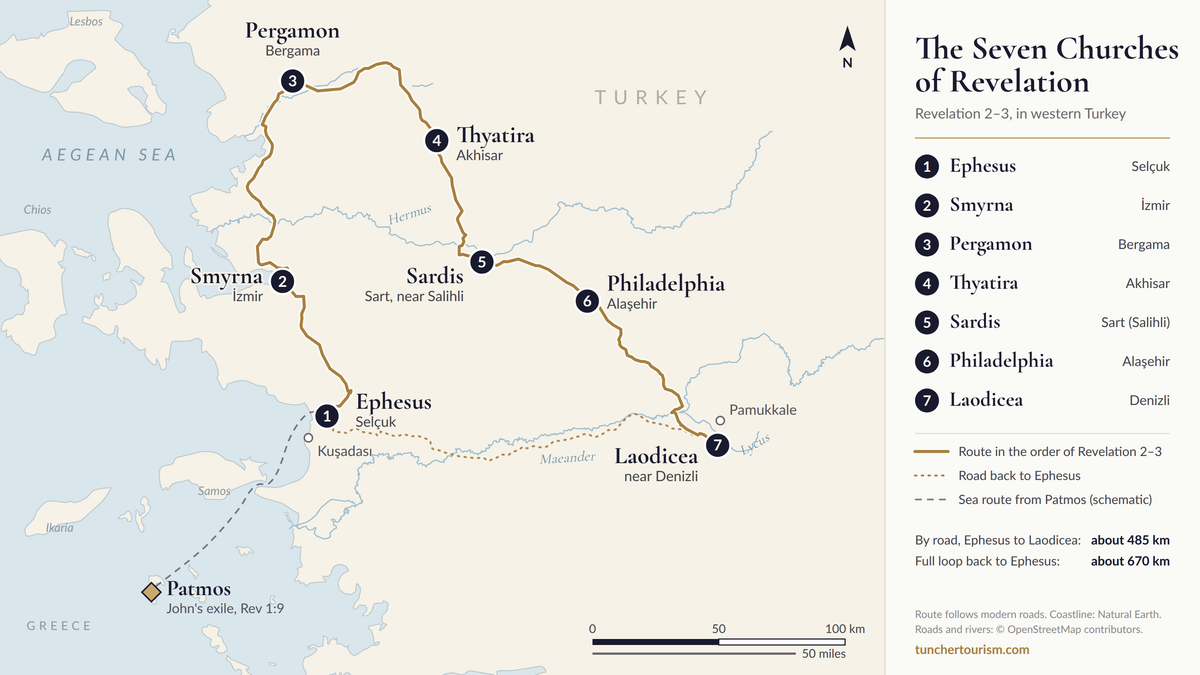
The full-size map (3200 × 1800 pixels) is easier to read on a phone or to print.
Ephesus (modern Selçuk) sits near the Aegean coast, about an hour south of Izmir and 25 minutes from Kuşadası cruise port. It is the easiest of the seven to reach.
Smyrna (modern Izmir) is the closest of the seven to Ephesus, about 75 km (45 miles) by road, and the only one that is still a major city, Turkey's third largest.
Pergamon (modern Bergama) lies about 115 km (70 miles) by road north of Izmir, with its acropolis rising above the modern town.
Thyatira (modern Akhisar) lies inland between Pergamon and Sardis. It is the least visited of the seven, because only a small excavated area survives in the town center.
Sardis (modern Sart, near Salihli) lies east of Izmir in the Hermus valley, with substantial ruins: the Temple of Artemis, a large bath-gymnasium complex and a synagogue.
Philadelphia (modern Alaşehir) lies farther east, with the massive pillars of the 6th-century Church of St John in the town center.
Laodicea (near modern Denizli) is the farthest from Ephesus, in the Lycus valley, a short drive from the white travertines of Pamukkale. Its excavated city is one of the largest of the seven.
In practice the trail splits into two halves. Ephesus and Smyrna are near the coast and close together, and each can be reached from Kuşadası or Izmir in a day. Pergamon, Thyatira, Sardis, Philadelphia and Laodicea form an inland arc that takes real driving time to connect.
The driving times show why. Izmir to Bergama is about 1.5 hours by road. From Bergama, Akhisar is about 1 hour 15 minutes, and Sardis another hour beyond that. Sardis to Alaşehir is about 40 minutes, and the last leg, Alaşehir to Laodicea, about 1 hour 15 minutes. No leg is long on its own, but the whole route from Ephesus to Laodicea is about 485 km (300 miles), or 6.5 hours of driving before you stop anywhere.
That is why many visitors treat the seven churches as two trips: Ephesus and Smyrna, easily added to a cruise stop or an Aegean holiday, and a separate inland circuit for those who want to complete all seven.
The Seven Churches at a Glance
1. Ephesus: The Church That Lost Its First Love
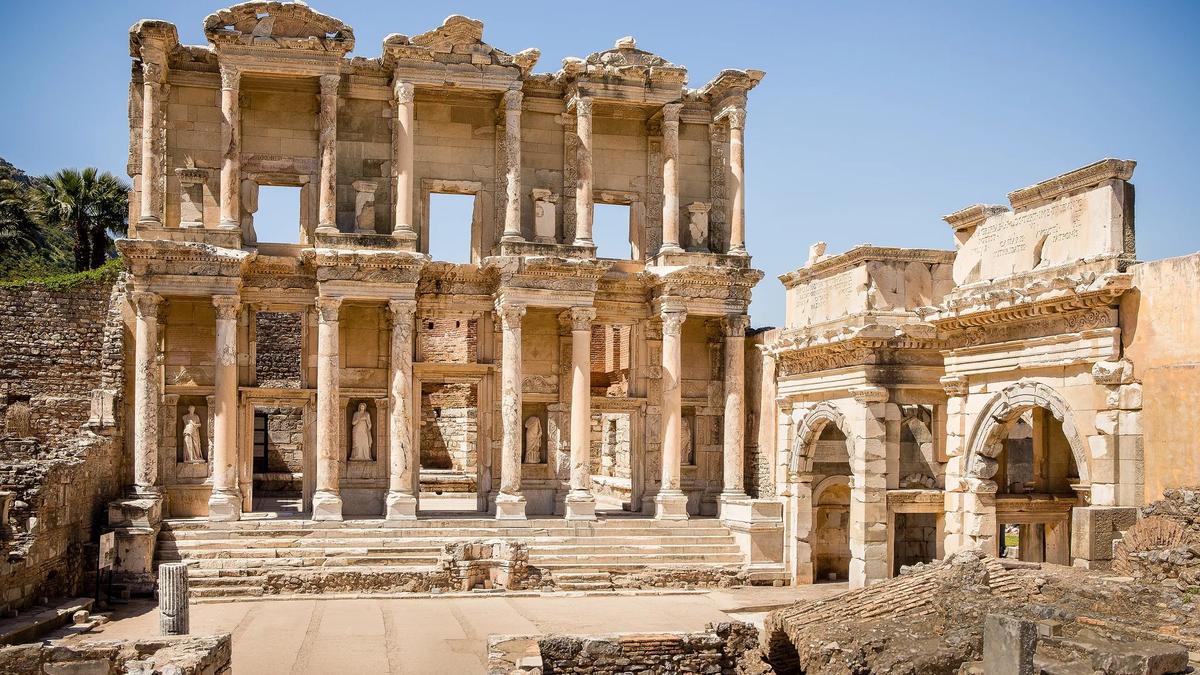
Revelation 2:1-7 praises Ephesus for its hard work, its perseverance and its testing of false apostles, then gives the letter's central warning: "You have forsaken the love you had at first." Paul had spent about three years in Ephesus (Acts 19; 20:31), longer than in any other city on his journeys, and by the time John wrote, the church there was strong in doctrine but had cooled in love. Ephesus is the largest and best preserved ancient city of the seven.
Read the full Church of Ephesus guide →
2. Smyrna: Faithful Unto Death
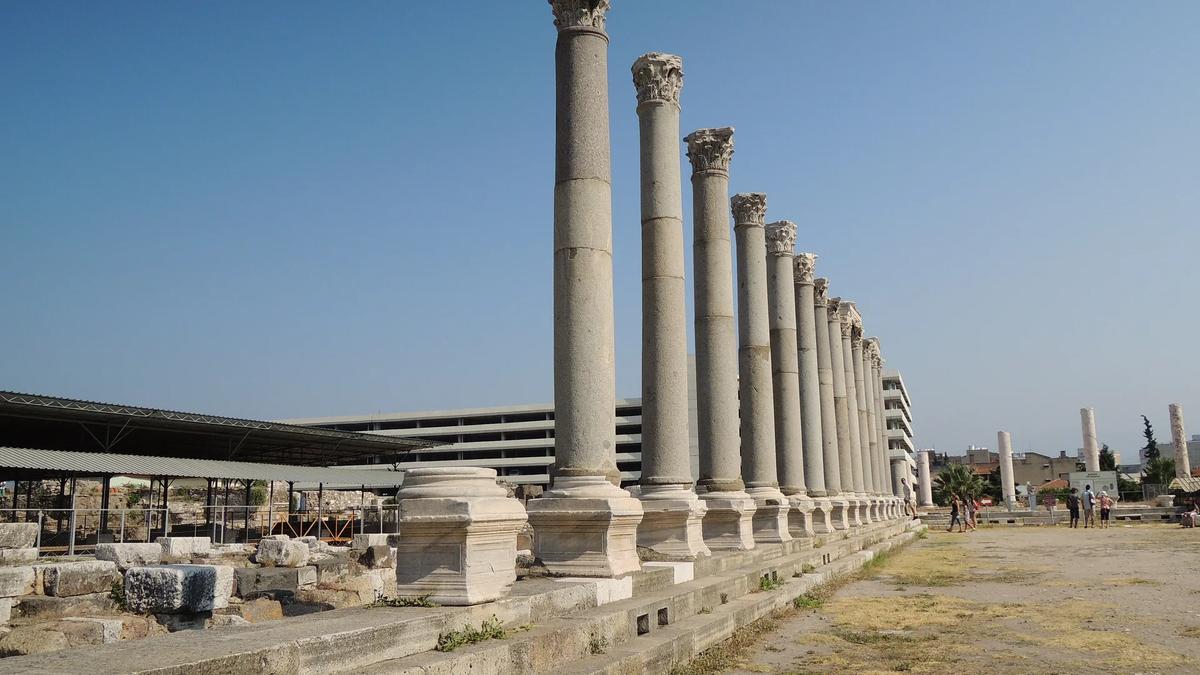
Revelation 2:8-11 is one of only two letters with no rebuke, only a call to endure suffering: "Be faithful, even to the point of death, and I will give you life as your victor's crown." Smyrna's church became a model of that endurance two generations later, when its bishop, Polycarp, was martyred in the city around AD 155 rather than renounce his faith. Smyrna is also the only one of the seven still a major city today, under its modern name, Izmir.
Read the full Church of Smyrna guide →
3. Pergamon: Where Satan's Throne Stood
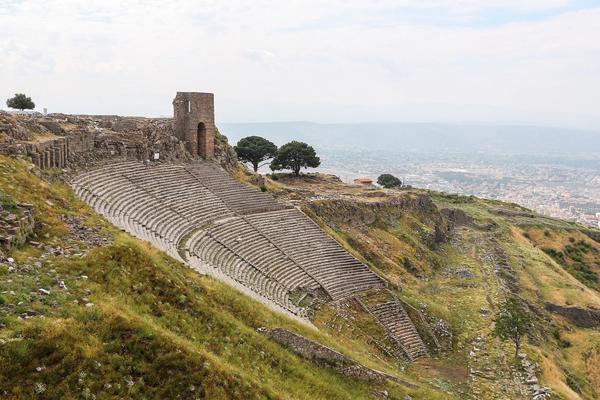
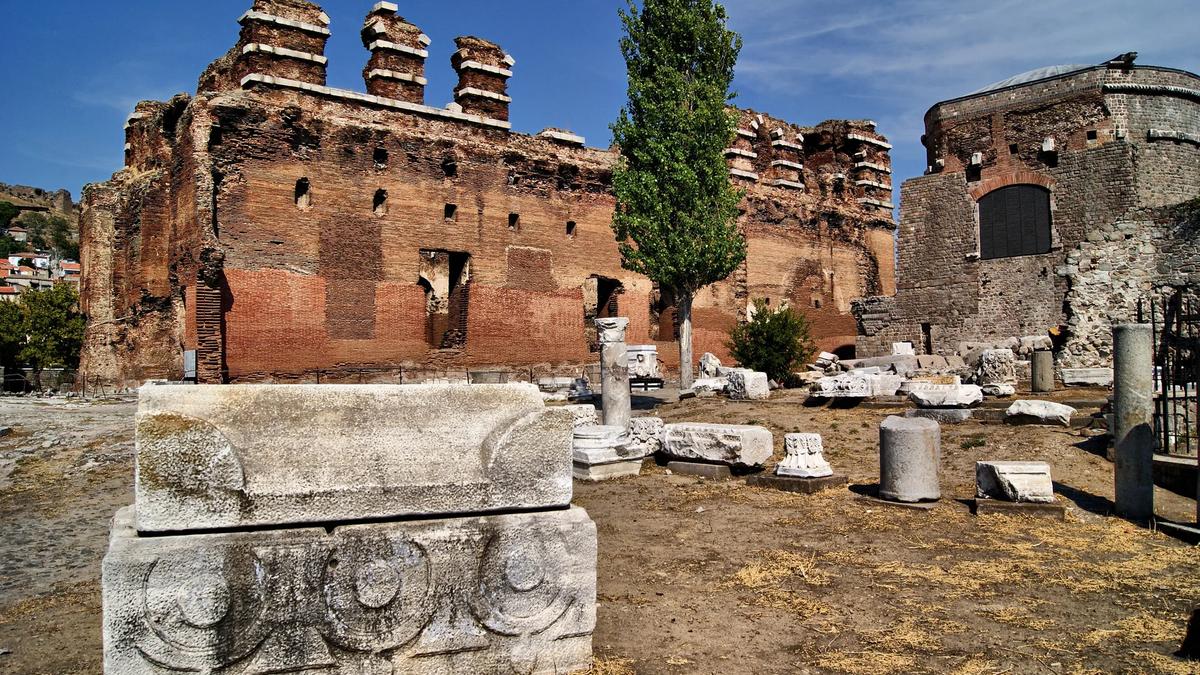
Revelation 2:12-17 praises the church for staying true "where Satan has his throne," a phrase scholars have linked to the city's Great Altar, its famous Asclepion healing sanctuary, or its role as a center of emperor worship. The letter also warns against those who hold to "the teaching of Balaam" and of the Nicolaitans, pointing to pressure from inside the congregation. Pergamon's acropolis, with its steep theatre and temple terraces, is one of the most dramatic ancient sites in Turkey.
Read the full Church of Pergamon guide →
4. Thyatira: The Warning Against a False Prophetess
Revelation 2:18-29 is the longest of the seven letters. It praises the church's love, faith, service and perseverance, then rebukes it for tolerating "that woman Jezebel, who calls herself a prophet." Thyatira was a city of trade guilds, including dyers (Acts 16:14 mentions "a woman from the city of Thyatira named Lydia, a dealer in purple cloth"), and the pressure to join guild feasts tied to pagan worship likely sits behind the letter's warning. Modern Akhisar is built directly over the ancient city.

Read the full Church of Thyatira guide →
5. Sardis: Alive in Name, Dead in Fact
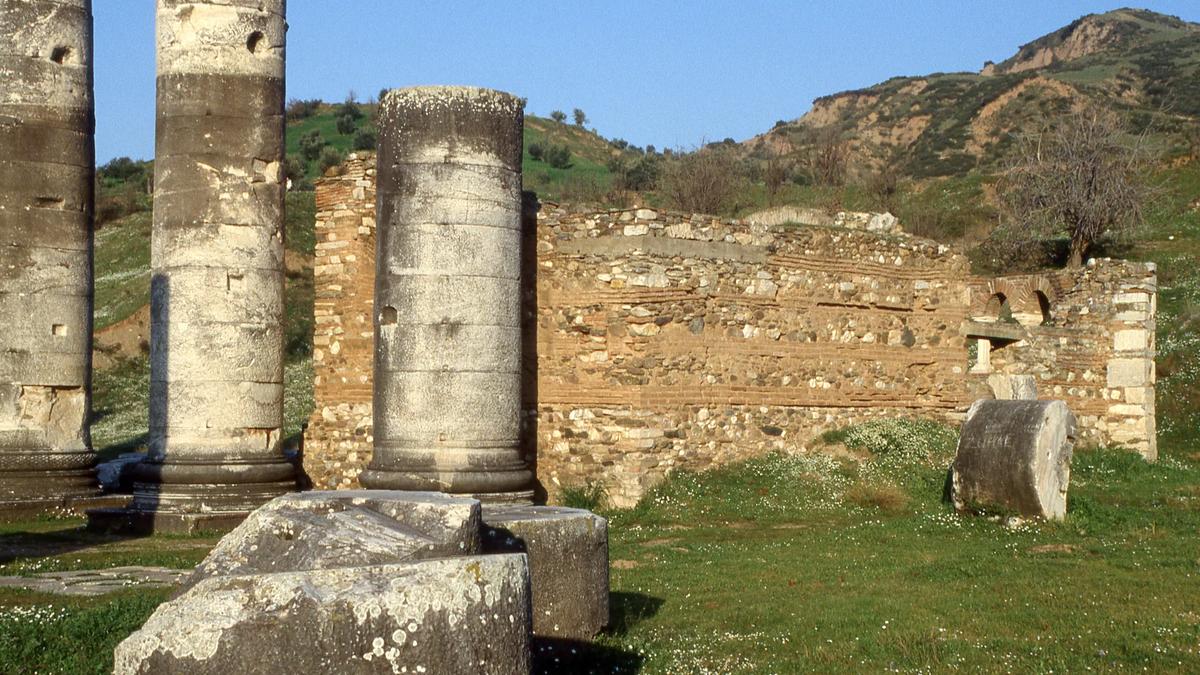
Revelation 3:1-6 has one of the bluntest lines in the book: "you have a reputation of being alive, but you are dead." Sardis had been the capital of the wealthy Lydian kingdom under King Croesus, and the warning that Christ will "come like a thief" fits a city whose citadel looked unassailable yet fell by surprise. Sardis today has substantial ruins, including the Temple of Artemis and one of the largest ancient synagogues ever excavated.
Read the full Church of Sardis guide →
6. Philadelphia: A Church With No Rebuke
Revelation 3:7-13 is one of the warmest of the letters: "See, I have placed before you an open door that no one can shut. I know that you have little strength, yet you have kept my word and have not denied my name." Like Smyrna's, it contains no criticism. Philadelphia lay in an earthquake zone and was rebuilt more than once, and the letter's promise to make the faithful "a pillar in the temple of my God" would have meant much in such a city. The pillars of a 6th-century church still stand in the center of modern Alaşehir.

Read the full Church of Philadelphia guide →
7. Laodicea: Neither Hot Nor Cold
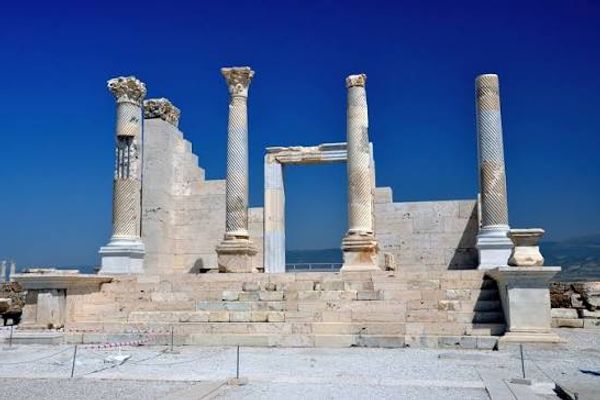
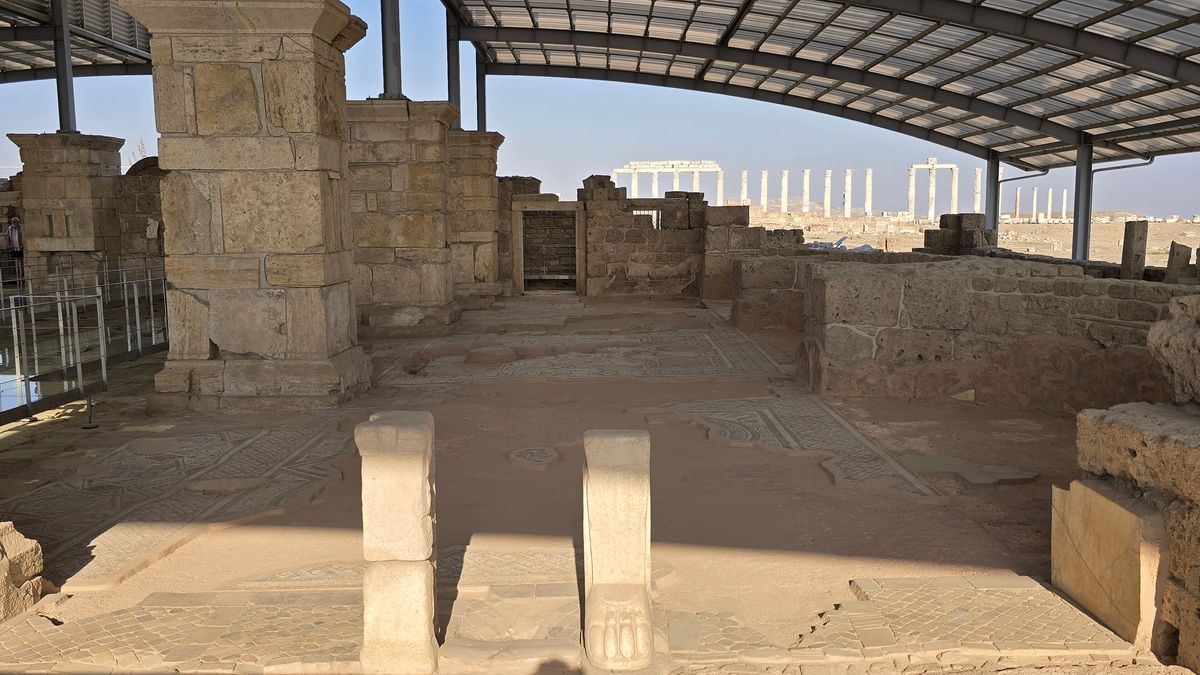
Revelation 3:14-22 contains the best-known line of the seven letters: "I know your deeds, that you are neither cold nor hot... because you are lukewarm, neither hot nor cold, I am about to spit you out of my mouth." Laodicea was wealthy, and the letter answers the church's boast "I am rich" by calling it "wretched, pitiful, poor, blind and naked." Many readers link the lukewarm image to the city's water, piped in from springs some distance away, set against the hot springs of nearby Hierapolis and the cold water of Colossae. Laodicea's excavations, which have grown steadily in recent years, include a 4th-century church, a stadium and two theatres.
Read the full Church of Laodicea guide →
What Survives Today: A Site-by-Site Snapshot
How much survives varies enormously across the seven, and knowing this in advance changes how much time each stop deserves.
Ephesus has by far the largest and best-preserved site of the seven, with the Library of Celsus, the Great Theatre and the Terrace Houses among its highlights. It easily fills a day on its own.
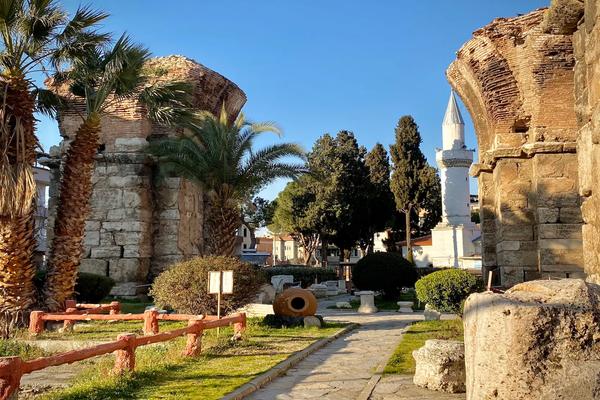
Smyrna (Izmir) preserves comparatively little above ground, since the modern city never stopped building on the same site, but the excavated agora gives a real sense of the Roman city.
Pergamon offers one of the most dramatic views on the trail: a steep acropolis theatre and temple terraces above the town, the Red Basilica in the lower town and the Asclepion healing sanctuary in the valley.
Thyatira has the thinnest archaeological record of the seven. Modern Akhisar sits on top of the ancient city, and only a small excavated area with part of a colonnaded street can be seen.
Sardis offers substantial ruins, including the Temple of Artemis, the bath-gymnasium complex and one of the largest ancient synagogues found anywhere.
Philadelphia preserves the pillars of a tall 6th-century church in the center of modern Alaşehir, a single monument rather than an extensive site.
Laodicea is a large excavated city where work has expanded steadily in recent years, with a major early church, a stadium and two theatres. Our Laodicea Ancient City visitor guide covers the site in detail, with opening hours and tickets.
Planning a Seven Churches Pilgrimage: How Many Days Do You Need
Most online lists of the seven churches imply they are equally easy to visit. They are not, and a realistic plan starts with how much time you have.
If you have one day: Visit Ephesus. It is the largest site, the easiest to reach from a Kuşadası cruise stop or an Izmir hotel, and the only one of the seven that fills most of a day on its own.
If you have two days: Add Smyrna (Izmir) and Pergamon. With one hotel night in Izmir you can see Ephesus and Smyrna on the first day and Pergamon's acropolis and Red Basilica on the second.
If you have three days: Add Thyatira on the way back from Pergamon and Sardis on the third day. That covers five of the seven.
If you have four days, the full circuit: Four days with three hotel nights is a realistic minimum for all seven. Ephesus and Smyrna on the first day, Pergamon and Thyatira on the second, Sardis and Philadelphia on the third with a night near Pamukkale, and Laodicea on the fourth before the drive back to the coast. Five or six days allow a slower pace and time at Pamukkale's travertines, a few minutes from Laodicea.
Travelers coming from outside Turkey should also plan their arrival. Izmir Adnan Menderes Airport is closest to the start of the trail and is the natural arrival point for a seven churches trip that does not begin with a Kuşadası cruise stop. From Istanbul it is easier to fly on to Izmir than to drive, which would add a full day of travel before the route even begins.
A few honest planning notes:
- Thyatira is the weakest stop for standing ruins. Build it in as a short stop with a focused historical explanation, not as a half-day destination.
- Sardis and Philadelphia are too far inland for a comfortable day trip from the coast and fit best with an inland overnight. Laodicea can be seen on its own as a 12-hour day trip from Kuşadası, or as the last stop of the full circuit.
- If your time is limited to a single port stop, Ephesus alone covers the first of the seven letters and the richest archaeological site, and adding the House of the Virgin Mary or St. John's Basilica rounds out the day without any inland travel.
Spring and autumn are the most comfortable seasons, since the inland valleys are much hotter in midsummer and Sardis and Laodicea in particular have little shade. A summer visit works with early starts at each site.
Decide early whether your goal is completeness or depth. A traveler set on standing in all seven cities will spend much of the trip in transit and will find little to see at Thyatira. A traveler more interested in depth may get more from spending the same time slowly at Ephesus, Pergamon, Sardis and Laodicea, and reading the other letters as context. Both are good ways to make the journey.
Our private Seven Churches tour from Kuşadası follows the four-day plan above, and there is the same tour starting from Izmir. With less time, the three-day pilgrimage covers Ephesus, Smyrna, Pergamon, Thyatira and Sardis, and the two-day pilgrimage Ephesus, Smyrna and Pergamon.
FAQ
What are the seven churches of Revelation?
Ephesus, Smyrna, Pergamon, Thyatira, Sardis, Philadelphia and Laodicea, in the order John addresses them in Revelation 2 and 3. Each was a Christian congregation in a city of the Roman province of Asia.
Where are the seven churches of Revelation today?
All seven sites are in western Turkey: Ephesus (Selçuk), Smyrna (Izmir), Pergamon (Bergama), Thyatira (Akhisar), Sardis (Sart, near Salihli), Philadelphia (Alaşehir) and Laodicea (near Denizli).
Were the seven churches actual churches?
Yes, in the first-century sense: real congregations of believers in seven real cities, not buildings. Christians then met in houses; Paul's letter to the Colossians greets "Nympha and the church in her house" near Laodicea (Colossians 4:15). The ruined churches you can visit today, such as those at Laodicea, Sardis and Philadelphia, were built centuries later.
Why did John write to these seven specific churches?
The seven cities lay on a single circuit route in the province of Asia, and each letter speaks to that city's situation, from persecution at Smyrna to complacency at Laodicea. Many readers also take the number seven as a sign of completeness, so that the letters speak to the whole church as well.
What do the seven churches represent?
First of all, real congregations with real problems. Because each letter ends with a call to hear "what the Spirit says to the churches," in the plural, they are also read as messages to every church. Some readers, following the notes of the Scofield Reference Bible (1917), see them as seven stages of church history, a reading Revelation itself does not state.
Are Paul's letters and Revelation's letters to the same cities connected?
In Ephesus's case, directly. Paul spent years in Ephesus and the New Testament includes a letter to the Ephesians, decades before John's letter in Revelation. Laodicea also appears in Paul's letter to the Colossians, which mentions a letter to the Laodiceans (Colossians 4:16), so Paul knew the congregation there before John's far more pointed letter.
Can you actually visit all seven churches?
Yes. Ephesus and Smyrna are easy to reach from the coast. The other five (Pergamon, Thyatira, Sardis, Philadelphia and Laodicea) need an inland route of several days. Patmos, where John received his vision, is a Greek island and is a separate trip by sea.
How many days do you need for the full seven churches tour?
Four days with three hotel nights is a realistic minimum for all seven, which is how our Seven Churches tour runs. Five or six days give an unhurried pace. Ephesus alone can be done in a day.
Is the seven churches trail suitable for older travelers or those with mobility concerns?
Ephesus, Pergamon, Sardis and Laodicea involve walking on uneven, sun-exposed ground with little shade. Smyrna's agora and Philadelphia's church need much less walking. Anyone with mobility concerns should plan a slower pace, build in rest stops, and consider a private guide who can adjust the route on the day.
Are any of the seven churches still standing?
The first-century congregations met in homes, and none of their meeting places survives. Later church buildings do: the 4th-century church at Laodicea, the small church against the Temple of Artemis at Sardis, the pillars of the 6th-century church at Philadelphia, and at Ephesus the Church of Mary and the Basilica of St. John.
Which of the seven churches still exists as a living city today?
Smyrna, now Izmir, is the only one of the seven that remains a major city on the same site. The others survive as archaeological sites, sometimes, as at Thyatira, almost entirely built over by their modern successor towns.
Which of the seven churches has the most to see?
Ephesus, by a clear margin. Laodicea, Pergamon and Sardis all have large, impressive ruins. Thyatira has the least to see, with only a small excavated area in modern Akhisar.
Do all seven letters follow the same structure?
Yes. Each opens with a title of Christ drawn from John's vision in Revelation 1, gives an assessment of the church, and closes with a promise "to the one who is victorious" and the call to hear what the Spirit says to the churches. Reading the seven together makes the pattern, and the variations within it, much easier to follow.
For pilgrims focused on the biblical and Marian sites around Ephesus, including Holy Mass times and faith-sensitive guiding, see our Biblical and pilgrimage tour options.
Visit all Seven Churches with a historian
A four-day private tour of Ephesus, Smyrna, Pergamon, Thyatira, Sardis, Philadelphia and Laodicea, for groups of up to 15.
See the Seven Churches tour →Starting in Izmir? See the tour from Izmir