
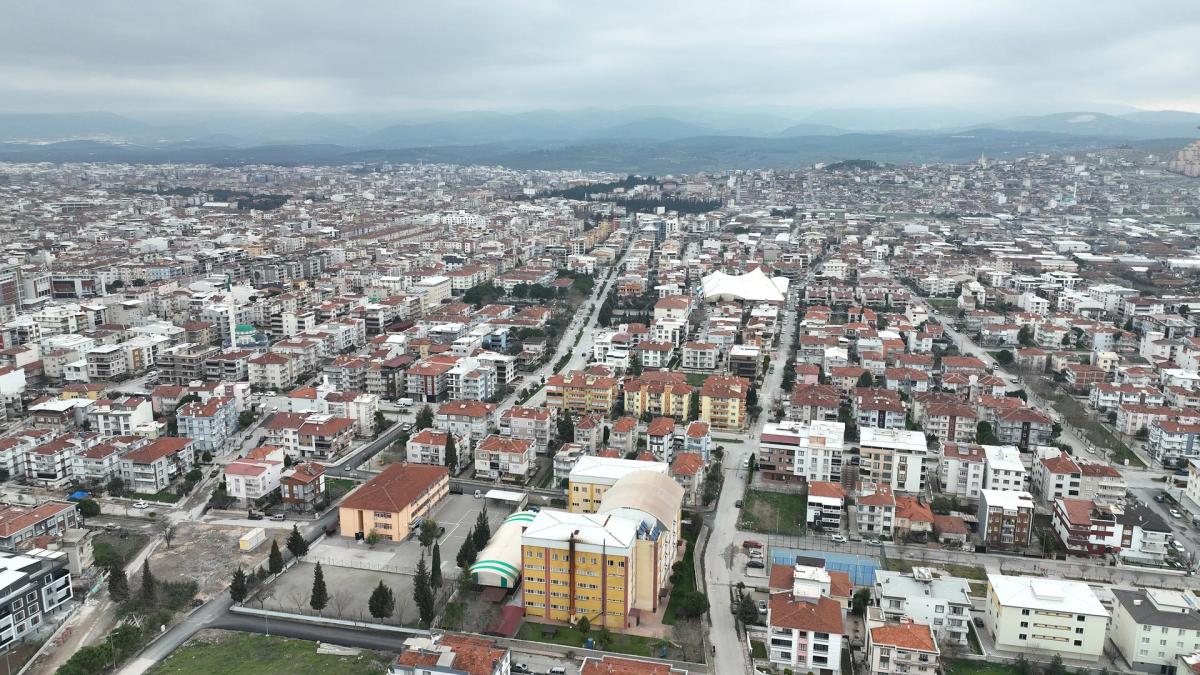
Short answer: The church of Thyatira was the Christian congregation of ancient Thyatira, now the town of Akhisar in Manisa province, western Turkey, about 115 km northeast of Izmir. Its letter (Revelation 2:18-29) is the longest of the seven. It praises the church's love, faith, service and perseverance, then rebukes it for tolerating "that woman Jezebel, who calls herself a prophet" and led believers into sexual immorality and eating food sacrificed to idols. Only a small excavated area of the ancient city can be seen today.
The church of Thyatira receives the longest of the seven letters in Revelation, though Thyatira is the least visited of the seven cities today. Modern Akhisar is built on top of the ancient city, and little of Thyatira survives above ground. What the city lacks in ruins, the letter makes up for in substance, and the city has a link to one of the best-known women in the New Testament, Lydia.
This article covers Revelation 2:18-29, the trade-guild pressure behind its warning, Thyatira's connection to Lydia in Acts 16, and what you can see in Akhisar. It is part of our Seven Churches of Revelation guide.
The Letter to Thyatira: Revelation 2:18-29
The letter is addressed "to the angel of the church in Thyatira" and presents Christ as "the Son of God, whose eyes are like blazing fire and whose feet are like burnished bronze," an image of searching judgment that prepares for the letter's main concern.
It opens with real praise: "I know your deeds, your love and faith, your service and perseverance, and that you are now doing more than you did at first" (Revelation 2:19, NIV). That is the reverse of Ephesus, which was told to "do the things you did at first." But the praise gives way to the most detailed rebuke of the seven: "Nevertheless, I have this against you: You tolerate that woman Jezebel, who calls herself a prophet. By her teaching she misleads my servants into sexual immorality and the eating of food sacrificed to idols."
Christ has given her "time to repent of her immorality, but she is unwilling," and he warns of suffering for her and her followers unless they repent, "Then all the churches will know that I am he who searches hearts and minds." To the rest in Thyatira, who "have not learned Satan's so-called deep secrets," he lays no other burden, only "to hold on to what you have until I come." The one who is victorious will receive "authority over the nations" and "the morning star." At the end of the book Christ calls himself "the bright Morning Star" (Revelation 22:16), so the promise is of Christ himself.
Who Was "Jezebel"? Trade Guilds and the Pressure to Compromise
"Jezebel" is almost certainly a label rather than the woman's real name. It recalls the Old Testament queen who led Israel into the worship of Baal (1 Kings 16-21), and it tells the first readers how John wanted this figure understood, whatever she called herself.
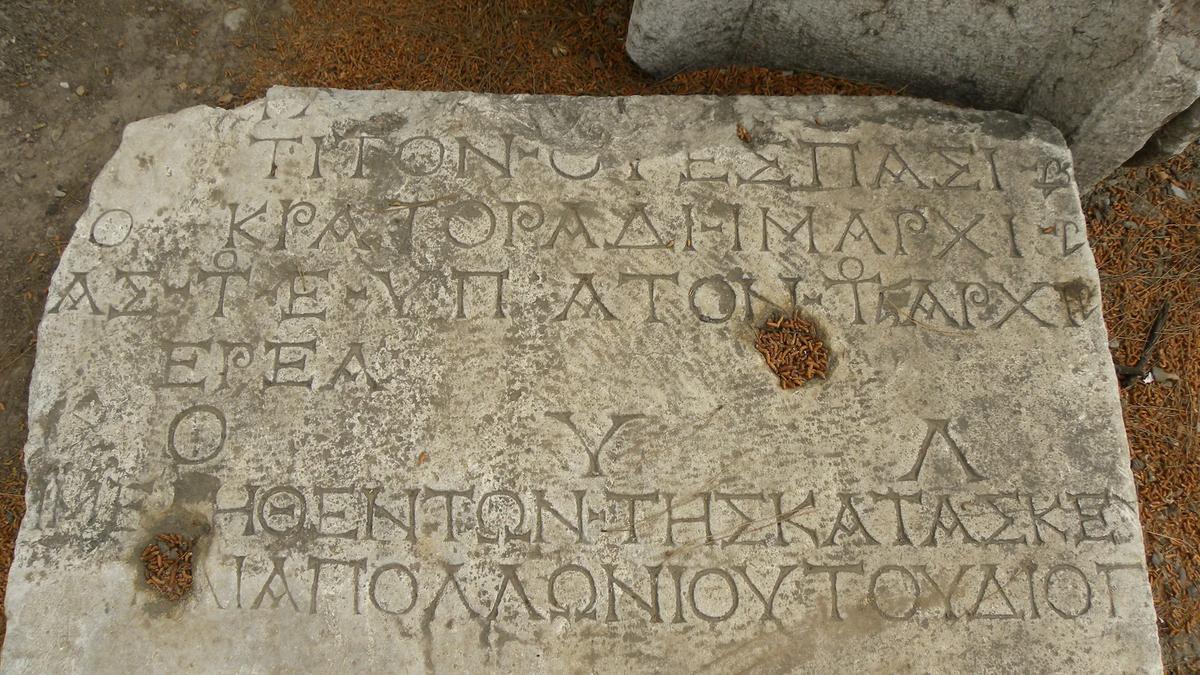
Her teaching, that "sexual immorality" and "food sacrificed to idols" could be tolerated, makes most sense against Thyatira's economy. More trade guilds are known from Thyatira than from any other city of the province of Asia. Inscriptions name wool-workers, linen-workers, makers of outer garments, dyers, leather-workers, tanners, potters, bakers, slave-dealers and bronze-smiths. Guilds held common meals in honour of their patron gods, where meat offered in sacrifice was eaten, and a craftsman who stayed away could lose contacts, work and standing.
That was a real dilemma for Christian artisans: refuse the guild feasts and risk exclusion, or attend and take part in what the church considered idolatry. The "Jezebel" figure seems to have offered a religious justification for joining in, a message that would have been attractive to a congregation under real economic pressure.
Why is this the longest letter? The others mostly describe one main condition: persecution at Smyrna, false teaching at Pergamon, complacency at Sardis. Thyatira's letter takes care to distinguish between the false teacher herself, those who follow her, and the rest of the congregation who have not accepted her teaching, and it speaks to each differently. That care, more than the city's size, explains its length.
Lydia of Thyatira: A Connection From Acts 16
Decades before Revelation, Thyatira appears in Acts 16:14, in the account of Paul's visit to Philippi in Macedonia: "One of those listening was a woman from the city of Thyatira named Lydia, a dealer in purple cloth. She was a worshiper of God." She is the first person in Europe recorded as believing Paul's message, and she was baptized with her household and hosted Paul and his companions in her home.
Her trade fits her home town. Inscriptions from Thyatira mention its guild of dyers, and Lydia, a Thyatiran selling purple cloth in Philippi, is an independent witness to how important cloth and dye were to the city, decades before John's letter named the pressures of guild life as a problem in its church.
Why So Little of Ancient Thyatira Survives
Unlike Ephesus, Sardis or Laodicea, Thyatira was never abandoned for a new site. Attacked again and again in the Middle Ages, it was rebuilt on its own ruins each time, and the busy modern town of Akhisar covers the ancient city. Most of what would have survived elsewhere has been built over, reused or buried.
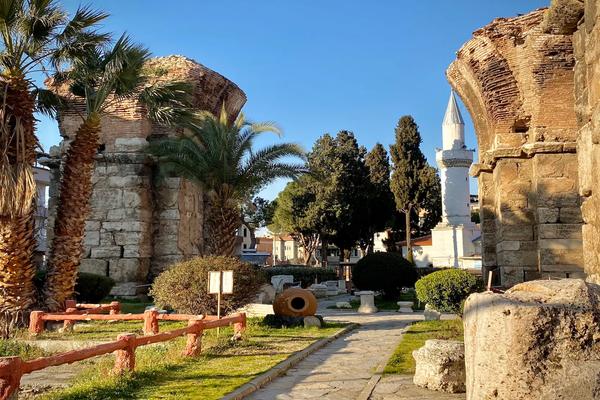
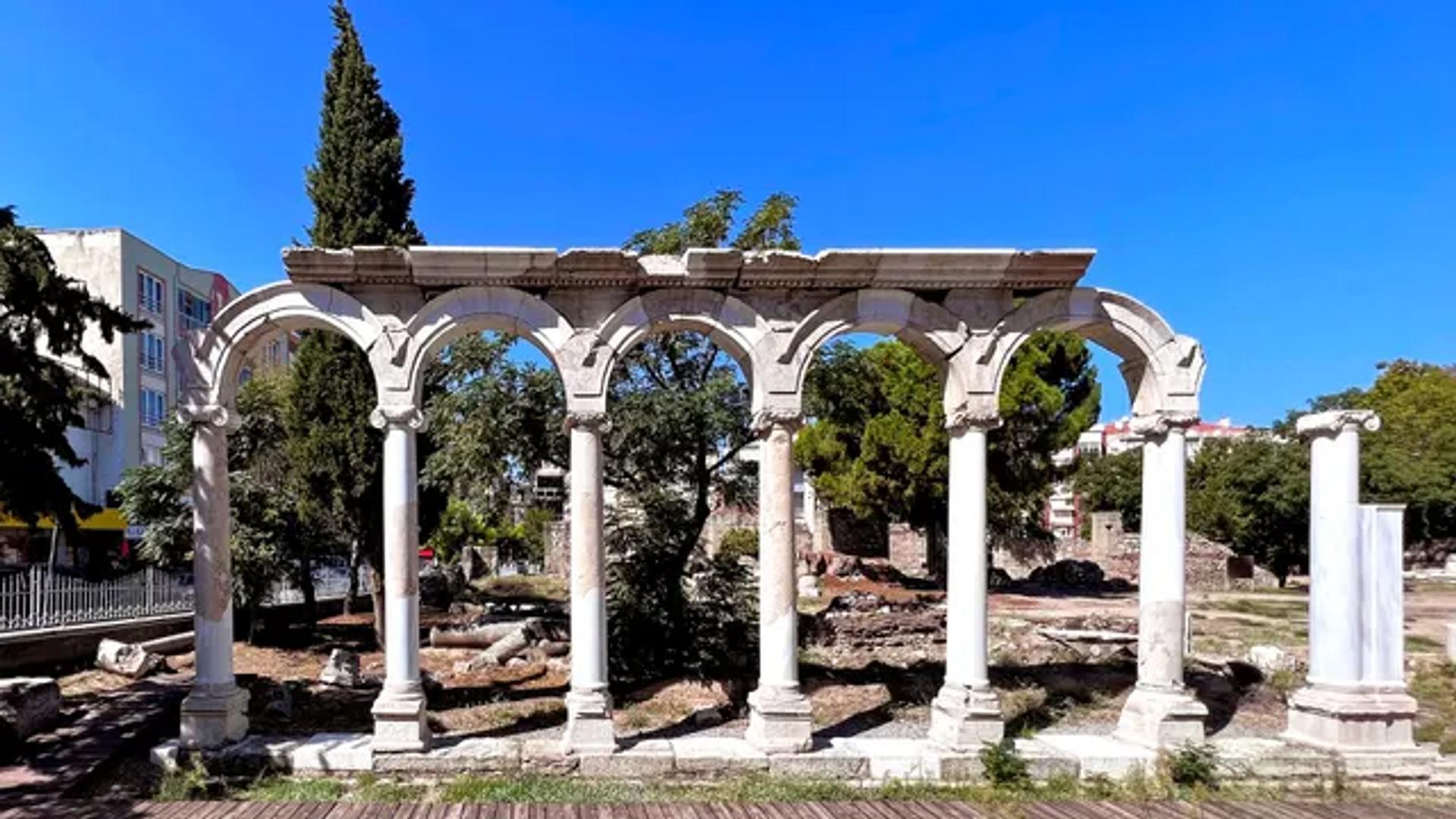
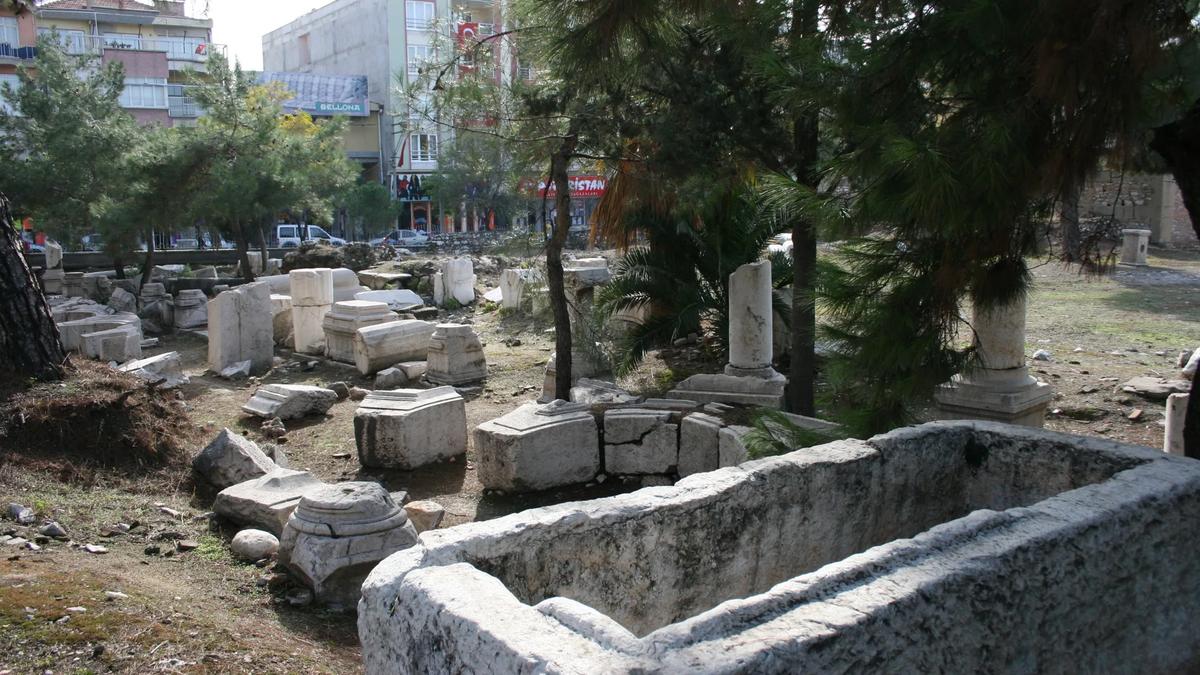
What you can see is a fenced excavated area in the town center, known as Tepe Mezarlığı, with part of a Roman colonnaded street, column bases and arches, walls of later buildings, sarcophagi and inscribed stones. Akhisar also has a small archaeological museum.

Visiting Thyatira
Akhisar lies inland between Pergamon and Sardis: about 1 hour 15 minutes by road from Bergama and about an hour from Sardis. From Izmir it is about 115 km (70 miles). Because the site is small, a visit of 30 minutes to an hour is enough, and it fits naturally between the two larger sites. Our map of the seven churches shows the route.
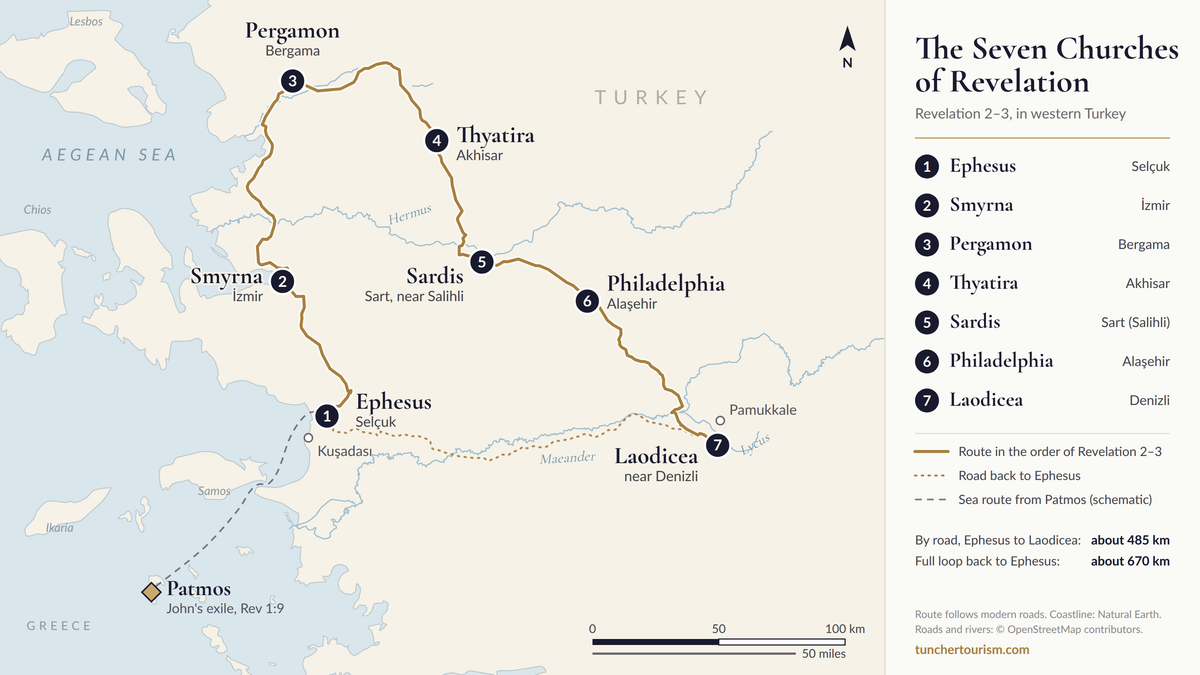
Because so little of ancient Thyatira is visible, it works better as a stop on a longer route than as a destination in itself. Our three-day pilgrimage takes it after Pergamon on the second day, with Sardis on the third. Our four-day Seven Churches tour visits Pergamon and Thyatira on the second day; it also runs from Izmir.
Frequently Asked Questions
Where is the church of Thyatira located today?
Ancient Thyatira lies under the modern town of Akhisar in Manisa province, western Turkey, about 115 km northeast of Izmir. The first-century congregation no longer exists; a small excavated area of the ancient city can be seen in the town center.
What is Thyatira called today?
Akhisar, meaning "white fortress" in Turkish. The town has covered the ancient city since the Middle Ages.
Who was "Jezebel" in the letter to Thyatira?
Almost certainly not her real name. John borrows the name of the Old Testament queen linked to idolatry (1 Kings 16-21) for a self-styled prophet in Thyatira who led church members into "sexual immorality and the eating of food sacrificed to idols," most likely by allowing them to take part in the trade guilds' feasts.
What was Thyatira known for?
Its trade guilds and crafts. Inscriptions name more guilds there than in any other city of the province, among them dyers, wool-workers, linen-workers, tanners, potters and bronze-smiths. Lydia, "a dealer in purple cloth" in Acts 16, came from Thyatira.
What does the name Thyatira mean?
An ancient writer, Stephanus of Byzantium, said King Seleucus I named it from the Greek word for "daughter" after hearing of his daughter's birth, but the name is probably older and Lydian.
What does the morning star mean in Revelation 2:28?
It is promised to the one who is victorious at Thyatira. At the end of Revelation, Jesus calls himself "the bright Morning Star" (22:16), so the promise is usually read as the gift of Christ himself.
Why does so little of ancient Thyatira survive today?
Unlike Ephesus, Sardis or Laodicea, Thyatira was never abandoned for a new site. Akhisar grew up on the same ground and was rebuilt over it for centuries, leaving only a small excavated area in the town center.
Is there still a church of Thyatira?
Not in Akhisar. The name lives on in the Greek Orthodox Archdiocese of Thyateira and Great Britain, created by the Ecumenical Patriarchate in 1922, whose archbishop lives in London.
For visitors completing the full seven churches circuit, Thyatira is best treated as a short, focused stop, valuable for the letter more than for ruins. To continue the trail, see the Church of Sardis. For the previous stop, see the Church of Pergamon. For the complete route and planning, see the Seven Churches of Revelation guide.
Visit all Seven Churches with a historian
A four-day private tour of Ephesus, Smyrna, Pergamon, Thyatira, Sardis, Philadelphia and Laodicea, for groups of up to 15.
See the Seven Churches tour →Starting in Izmir? See the tour from Izmir